
Progress
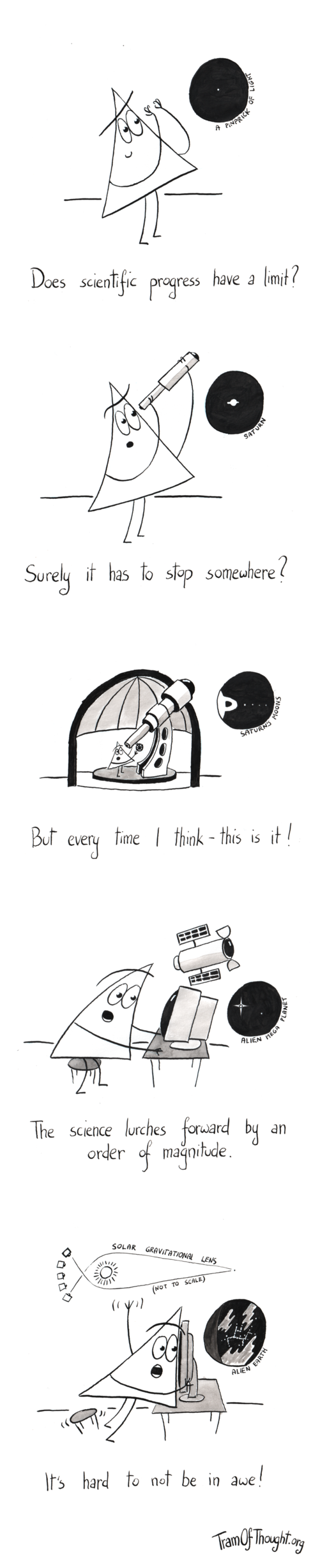
A Triangle-person is looking at the sky using a pretend telescope made out of curled hands. A small circle shows what they see - just blackness with a pinprick of light. Subtitle: “Does scientific progress have a limit”?
The same person is holding a small telescope to their eye. They see a planet with ears - Saturn. Subtitle: “Surely it has to stop somewhere?”
Now they are sitting in an observatory at a large telescope. They see moons of Saturn. “But every time I think - this is it!”
Next they stare at a computer screen, Hubble telescope hovering over them. They see a star and next to it a dot of light - an alien mega planet. “The science lurches forward by an order of magnitude.”
Finally, they sit at a flat-screen monitor peering at it and wildly gesticulating. Above them there is a schematic of a number of telescopes placed far out in space, using Sun as a gravitational lens. They see an alien Earth, and there is some city lights visible on the dark surface of the planet. “It’s hard not to be in awe!”
| Instrument | Aperture | Resolution | km @ 100 ly |
|---|---|---|---|
| Eye | 7mm | 60 arcsec¹ | 275 billion km |
| Galileo’s telescope | 15mm | 10 arcsec² | 50 billion km |
| 19th century observatory | 1m | 1 arcsec² | 5 billion km |
| Hubble space telescope | 2.4m | 0.05 arcsec | 230 million km³ |
| Solar gravitational lens⁴ | 1.45 million km | 0.000000001 arcsec | 5 km |
¹ Assuming full dilation with night vision adaptation when looking at a bright object.
² Atmosphere interferes with obtaining a clean image.
³ This is sufficient to resolve some giant planets as points of light by using a coronagraph (a star-blocking device) - e.g. see HR 8799 b, c and d.
⁴ Sun’s gravity bends light, so in principle it can be used as a giant lens. This is obviously untested and the values are rough estimates of what might be possible - but we should be able to resolve geographic or weather features on Earth-sized exoplanets (city lights are my dramatization 😛)