Mechanics
Orthodox Mechanics
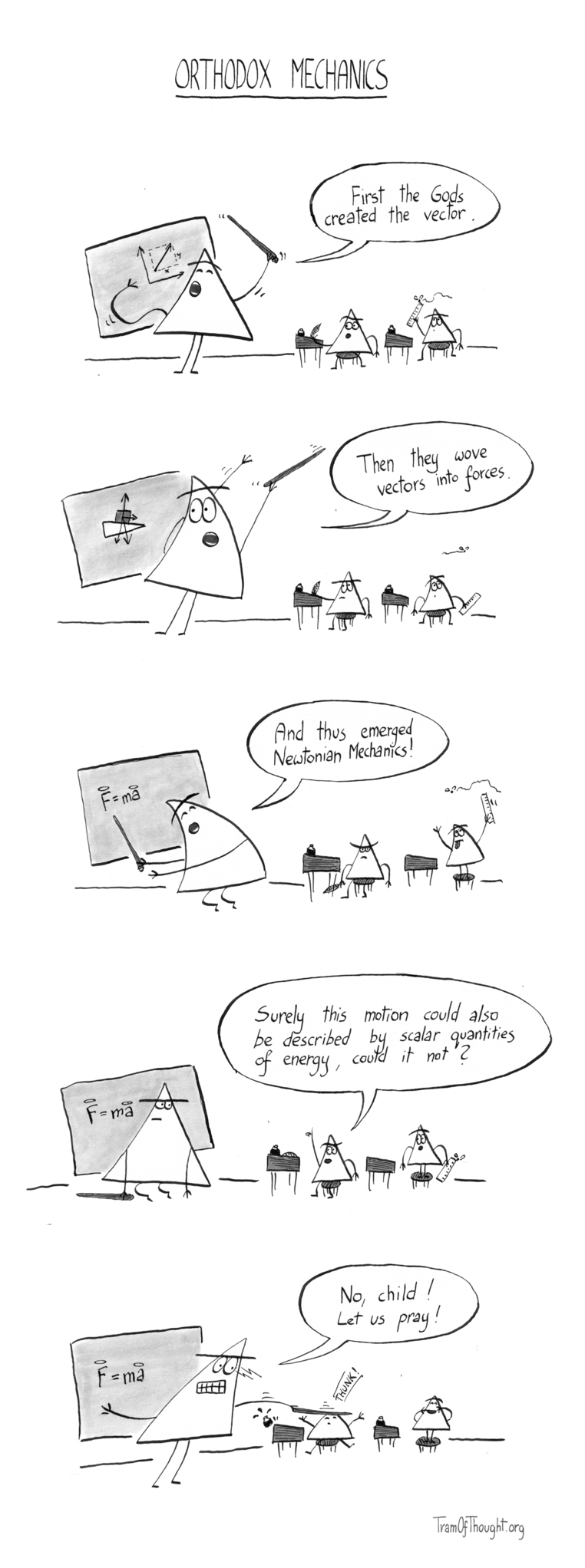
A Triangle-teacher is standing in front of the class, loudly explaining: “First the Gods created the vector.” They are holding a wooden pointer stick and there is a vector drawn on the chalkboard. The Triangle-student in front is paying attention, the student at the back is trying to hit a fly with a ruler.
The Triangle-teacher is now showing an object on an inclined plane, exclaiming: “Then they wove vectors into forces.” The first student is frowning, the second one is still trying to catch the fly.
The Triangle-teacher is now showing F=ma equation, but instead of vector symbols above F and a, there is little aureolas. They are kneeling, bowing slightly towards the chalkboard: “And thus emerged Newtonian Mechanics!” The first kid is now frowning even harder. The rear student is standing on their stool trying to reach the fly.
The front student now says: “Surely this motion could also be described by scalar quantities of energy, could it not?” The second student is still standing on the chair, but is now paying attention. The teacher is frowning hard, looking back at the front student.
The teacher is now hitting the front student with their pointer stick and a “Thud” sound. The front student looks flattened, and the rear student is laughing. The teacher exclaims: “No, child! Let us pray!”
It took me some decades to discover that Newtonian Mechanics (the pointy-arrows kind) is not the only one around suitable for explaining how blocks slide down inclined planes and pendulums oscillate.
This is down to how I was taught - physics was a pretty dry affair, and there never was much room to gain perspective. I was likely only shown Newtonian Mechanics because it’s so easy to teach - it uses primary-school algebra to model (predict) real-world behaviour of objects. Newtonian concepts also easily link up with intuitions.
There are other models that predict the same thing. One of them is Lagrangian Mechanics. I only understand it in a very shallow way, but the short of it is: where Newtonian works with vectors and forces, Lagrangian works with scalars (single numbers) and energies. Both are considered “classical” models, and they can be even mathematically reduced (converted) to each other.
This reminds me of the Bohr’s planetary model of the atom. This particular metaphor is so strong people always visualise nuclear stuff as a bunch of balls orbiting more balls, which is useful but fictional. Same with Newton - “force” and “inertia” are concepts we treat as real, tangible things, but they just come from this very successful model of the world.